

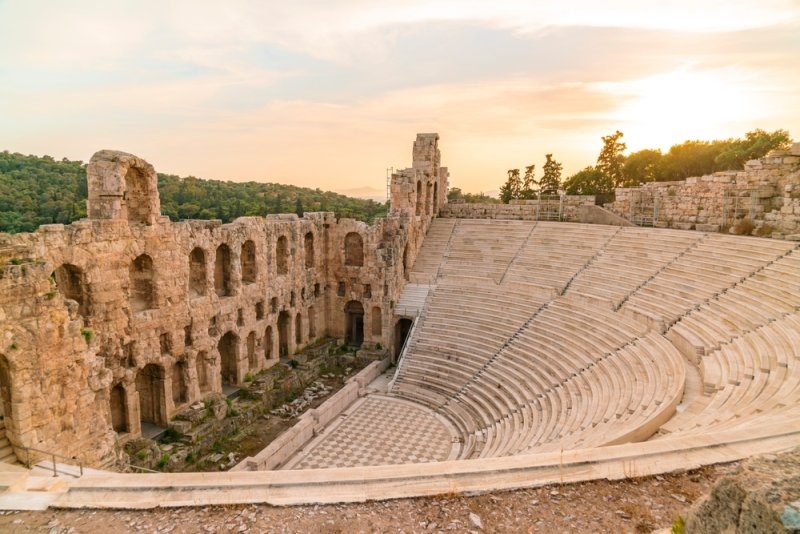
You probably picture Greece as whitewashed houses, blue sea, old stones, and grilled fish. But honestly, that image skips so much. Greek culture is older, messier, louder, and way more mixed into daily life than most visitors expect. Ancient traditions pop up in how people talk, cook, celebrate, build, and gather with family.
Knowing these little things makes any trip way more fun. They’re why people keep coming back for more. That’s what you’ll get in this blog: 25 facts about Greece that make its culture, travel, and everyday life make sense.
Whether it be democratic ideals, philosophical foundations, or common terms used in everyday speech, many of the elements of modern society have their beginnings in the innovations of the Ancient Greeks.
The early democracy of the ancient Greeks (5th century BC) evolved in Athens. By the standards of the modern day, it was restricted; even though it did not include women, the enslaved, or foreigners, the structure of participation in direct decisions in the public sphere was hugely influential.
Greek has a written and oral history stretching back more than 3,000 years. Its vocabulary also shaped modern terms used in philosophy, medicine, science, mathematics and technology. That makes the language a living piece of Greek culture, not simply an ancient relic.
Every four years at Olympia, celebrations were held for Zeus; this is known as the ancient Olympic Games. The meeting took place for a period of five days, and people from various Greek communities gathered. Today, the ancient town of Olympia joins the past with the present of the Olympic Games.
Mount Olympus became famous in Greek mythology as the home of the Olympian gods. It is also Greece’s highest mountain, so the location was not just mythically impressive. Its landscape, stories and biodiversity now give Greece travel another reason to look beyond beaches.
Zeus, Athena, Poseidon, Aphrodite and other mythological figures appear constantly in books, films, games and advertising. The stories survived because they deal with jealousy, ambition, love, pride and revenge — very human problems, despite the supernatural setting.
Recommended Article: 10 Fascinating Facts About Japanese Culture and Traditions
Unlocking the story behind local traditions, cuisine, and ancient landmarks transforms a standard Greek vacation into an immersive journey.
Greece includes around 6,000 islands and islets scattered across its seas, although only a fraction are inhabited. The islands differ sharply in landscape, architecture and local traditions. So one island trip does not necessarily tell you much about the next.
One of the most useful things to know about Greece is that the country is not only its islands. The mainland has mountain villages, archaeological sites, forests, coastal towns and regional food traditions. For Greece travel, that means there is plenty beyond Santorini and Mykonos.
This is what modern Athens is like with thousands of years of history in it, traffic and cafés galore. It is a modern city with the Acropolis and Parthenon nestled amongst the modern city buildings. In this intersection of ancient and ordinary life, the relics of history and quotidian existence intertwine.
In fact, Greece is more than a tourism slogan – it's a country that prides itself on its hospitality. Guest-giving has always been important in the culture, as told in ceremonies, family dinners, and social traditions. Treating guests kindly is closely related to the Greek term philoxenia, which can be interpreted as ‘love of strangers'.
Greek culture is not completely uniform. Crete, the Cyclades, Epirus, Macedonia, the Peloponnese and the Ionian Islands have different foods, landscapes, accents and traditions. That regional variety is one of the most overlooked Greece facts when people imagine the country as one single postcard.
While famous for its sun-soaked islands and ancient monuments, Greece offers a far richer tapestry of vibrant local traditions, diverse landscapes, and deep-rooted culinary heritage waiting to be discovered.
For centuries, olive planting has influenced Greek agriculture, cuisine and culture. It seems everyone's meals include olive oil, whether it's on a salad, in vegetables, on bread, in seafood, and so on. Food is one of the easiest things for the visitor to experience Greek culture without visiting a museum.
Food is not generally eaten in a hurry. Families and friends may share several dishes, linger at the table, and keep talking long after the meal arrives. This social side of eating is one of the simplest things to know about Greece.
Meze refers to small dishes served together, often including dips, vegetables, seafood, cheese or meat. Instead of everyone ordering one isolated plate, food can become communal. It changes the rhythm of a meal — slower, louder, more social.
Greek coffee is traditionally prepared in a small pot and served strong, usually with grounds settling at the bottom of the cup. It is not simply a caffeine stop. Coffee can provide a moment of pause in a busy day, particularly in the village and also the café.
Authentic Greek feta has protected designation of origin status within the European Union. It is traditionally made from sheep’s milk, sometimes with goat’s milk. That makes the cheese more than a generic salad ingredient; it is tied to specific production traditions.
Further Reading: Exploring Africa's Tribal Cultures and Rich Traditions
Before packing your bags for the cradle of Western civilization, keep these essential cultural quirks, travel tips, and local customs in mind for a smooth journey across Greece.
Santorini’s dramatic cliffs and unusual shape come from major volcanic activity. The island’s famous caldera is part of that geological story. The result is a landscape that looks almost artificial in photographs, especially around Oia and the caldera-facing villages.
Volcanic geology creates beaches with darker sand or pebbles in several areas. Santorini is the obvious example, but Greece has plenty of coastline beyond the standard golden-sand image. Greece tourism is much more varied geographically than its most famous photographs suggest.
Village festivals, religious celebrations, music and regional food remain important in many parts of Greece. These events can feel completely different from the polished experience of major tourist centers. For Greece travel, timing a visit around a local festival can change the entire experience.
Summer evenings and outdoor cinemas have a special place in Greek urban life. Watching a film under the night sky is a very different experience from sitting inside a conventional theater. It also fits Greece’s warm-weather social rhythm surprisingly well.
A traditional taverna can function as a social meeting place as much as somewhere to eat. Food, conversation, drinks and local routines overlap. This is why understanding Greek culture through restaurants alone can still be useful — you are watching social life happen.
Beyond its postcard-perfect islands and ancient ruins lies a country filled with unexpected quirks, unique local customs, and fascinating history that continuously catches travelers off guard.
With thousands of islands plus a mountainous mainland surrounded by sea, Greece has an unusually varied coastline. Bays, coves, sandy beaches, cliffs and volcanic shores all appear. That variety explains much of the country's appeal to Greece tourism.
Greece is not flat beach territory. Mountain ranges run through large parts of the mainland, creating forests, hiking routes and highland villages. This makes Greece travel surprisingly good for travelers who want walking, nature and cooler landscapes.
Letters such as alpha, beta, gamma, delta and pi are now familiar in mathematics, physics and science. The alphabet itself is ancient, but its influence remains extremely practical. You may be using Greek letters without realizing how often they appear in modern life.
Greek archaeological heritage is not always separated from ordinary life. Athens is the clearest example, where ancient monuments stand beside shops, homes, restaurants and busy streets. That overlap is one of the most fascinating things to know about Greece.
The biggest takeaway from these Greece facts is that the past has not disappeared. Mythology, food, language, hospitality, architecture and festivals still connect modern Greeks with older traditions. Greek culture survives because it keeps changing rather than staying frozen.
Here's Something Helpful: Hidden Cultural Traditions Americans Are Discovering in 2026
A great trip here isn’t just ticking boxes. It’s about watching life as it happens—how locals eat, how villages come together, how old and new buildings sit side by side, how food changes from one region to another.
If you pay attention to these moments, your trip becomes unforgettable. That’s what hooks travelers: not just beaches and ancient ruins, but all the small habits and quirks you can’t get in a picture.
If you remember just one thing, let it be this: Greece isn’t a single experience. It’s a patchwork of landscapes, history, community, and traditions—Greek culture ties it all together.
Yes. Greece is part of the Schengen Area and, in general, travellers coming from a country where a Schengen visa is required must satisfy the Schengen visa entry requirements prior to their arrival.
Greece runs on the euro. In big cities and tourist hotspots, cards work almost everywhere. Still, it’s smart to have a little cash on hand—some smaller shops, old-school cafés, or village spots might still prefer it.
Most people use ferries—they’re the go-to for hopping between islands. If you’re in a rush or going a longer distance, domestic flights can be a lifesaver. Honestly, the best route depends on which islands you’re heading to and the time of year.
On the mainland, tap water is usually safe. But things change once you hit the islands—the quality can be hit or miss. It’s always a good idea to ask locals or your hotel if you’re not sure.
Yes, especially in places where tourists hang out—hotels, restaurants, and most city spots. If you wander off the beaten path, English won’t be quite as common, but you’ll usually be able to get by with basics.
This content was created by AI